How to Specify Freeze-Dried Fruit for Cereal, Granola, Chocolate and Dairy Applications
There is no single freeze-dried fruit specification that fits every food product. A cereal inclusion, granola piece, chocolate ingredient and yogurt topping face different handling and moisture conditions. Before requesting bulk freeze-dried fruit ingredients, define the application, fruit format, target piece size, texture objective, acceptable breakage, processing route and final packaging. Those decisions give the sample trial a purpose and create a clearer basis for the commercial specification and quotation.
Start With the Application, Not the Fruit Format
Begin with how the fruit enters the finished product. Is it blended into a dry cereal, folded into granola after processing, embedded in chocolate, added to a dry dairy preparation or packed separately as a yogurt topping? The answer changes the useful format and the way a sample needs to be tested.
Processing route
Record when the fruit is added, the mechanical handling it receives and any heat, moisture or oil exposure. A format that looks good in the sample pouch may not retain the same size or texture after processing.
Finished-product objective
Decide whether the fruit must remain visibly identifiable, distribute evenly, contribute crunch, release flavor, provide color or rehydrate in use. These objectives do not always point to the same format.
The application trial should also reflect the intended packaging and shelf-life expectations. A dry blend in a moisture-barrier pouch creates a different environment from fruit placed directly inside a high-moisture dairy product.
Which Freeze-Dried Fruit Format Should You Specify?
| Format | Typical application fit | Main advantage | Buyer should evaluate |
|---|---|---|---|
| Whole fruit | Visible inclusions, decoration and retail presentation | Strong fruit identity | Size variation, fragility, breakage and distribution |
| Slices | Cereal, toppings, decoration and snack applications | Large visible surface | Thickness, diameter, color, bite and broken pieces |
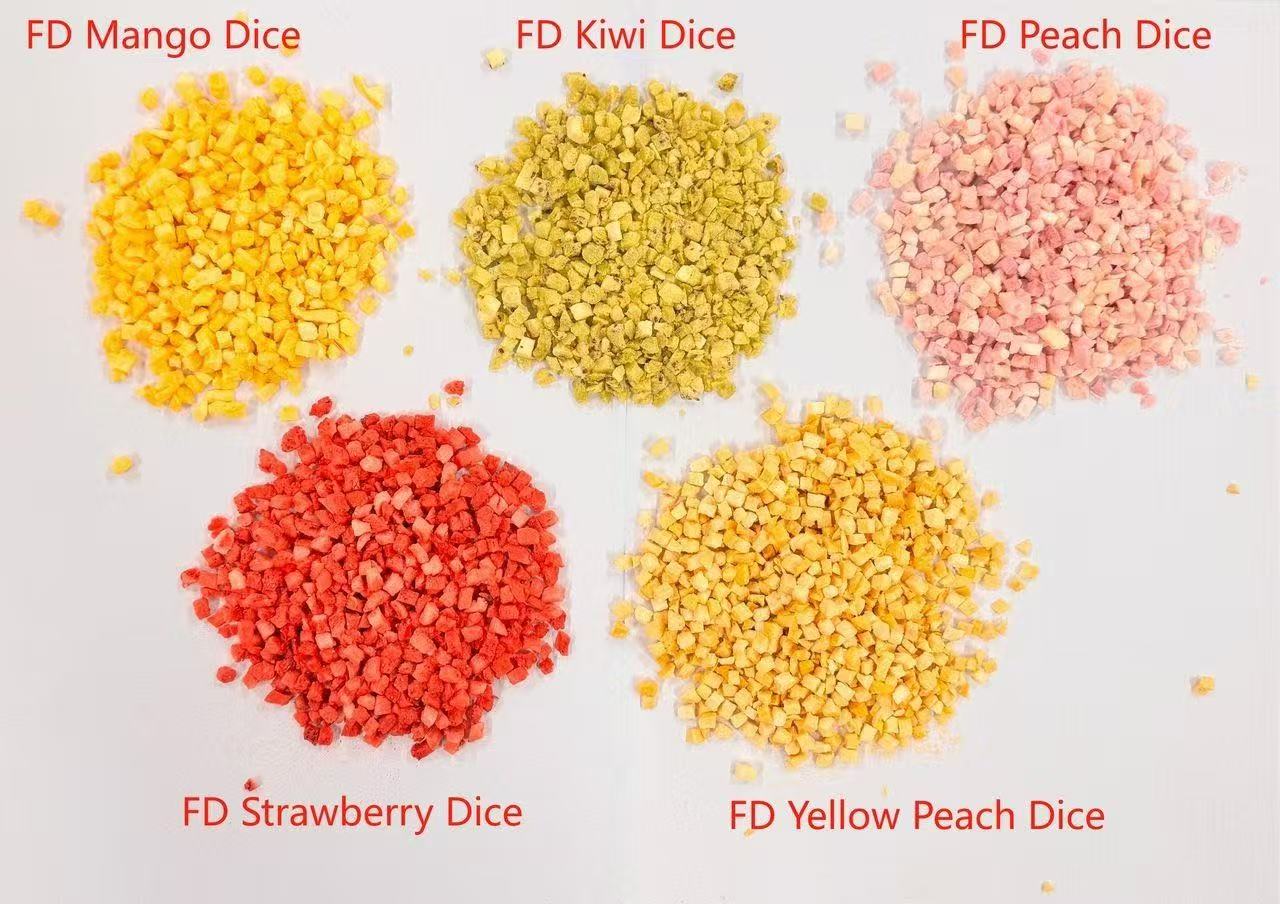
| Pieces / dices | Cereal, granola, chocolate, bakery and mixed ingredients | Easier dosing and more even distribution | Size range, fines, blending loss and equipment fit |
| Granules | Smaller inclusions, coatings and mixes | Broad distribution through a formulation | Particle range, dust, flavor impact and handling |
| Powder | Flavor, color, bakery mixes, confectionery and dry beverages | No intact fruit structure required | Ingredient declaration, particle behavior, moisture protection and flow expectations |
Freeze-Dried Fruit for Cereal
Cereal manufacturers need a format that distributes through the blend and survives mixing, filling and transport with an acceptable amount of damage. Compare the fruit size with the cereal components and serving size. Large pieces can look attractive but may distribute unevenly, separate because of bulk-density differences or break during handling.
Review crispness, visible fruit identity, fines after mixing and moisture pickup in the finished pack. The largest or most visually attractive piece is not automatically the most practical cereal inclusion. Packaging-barrier performance and storage conditions need to support the complete cereal system, not just the fruit before blending.
Freeze-Dried Fruit for Granola
Granola adds another variable: the size and hardness of the clusters. Fruit that is much smaller than the clusters may settle; fragile slices may break when mixed with dense components. The incorporation point also matters. Do not assume the fruit should pass through the granola baking process. The manufacturer's R&D team should test when it is added and what heat, oil, moisture and mechanical exposure it receives.
During the trial, examine fruit distribution, breakage, final bite and any change after packaging. A piece that is suitable for a light cereal blend may need adjustment for a denser granola formulation.
Freeze-Dried Fruit for Chocolate and Confectionery
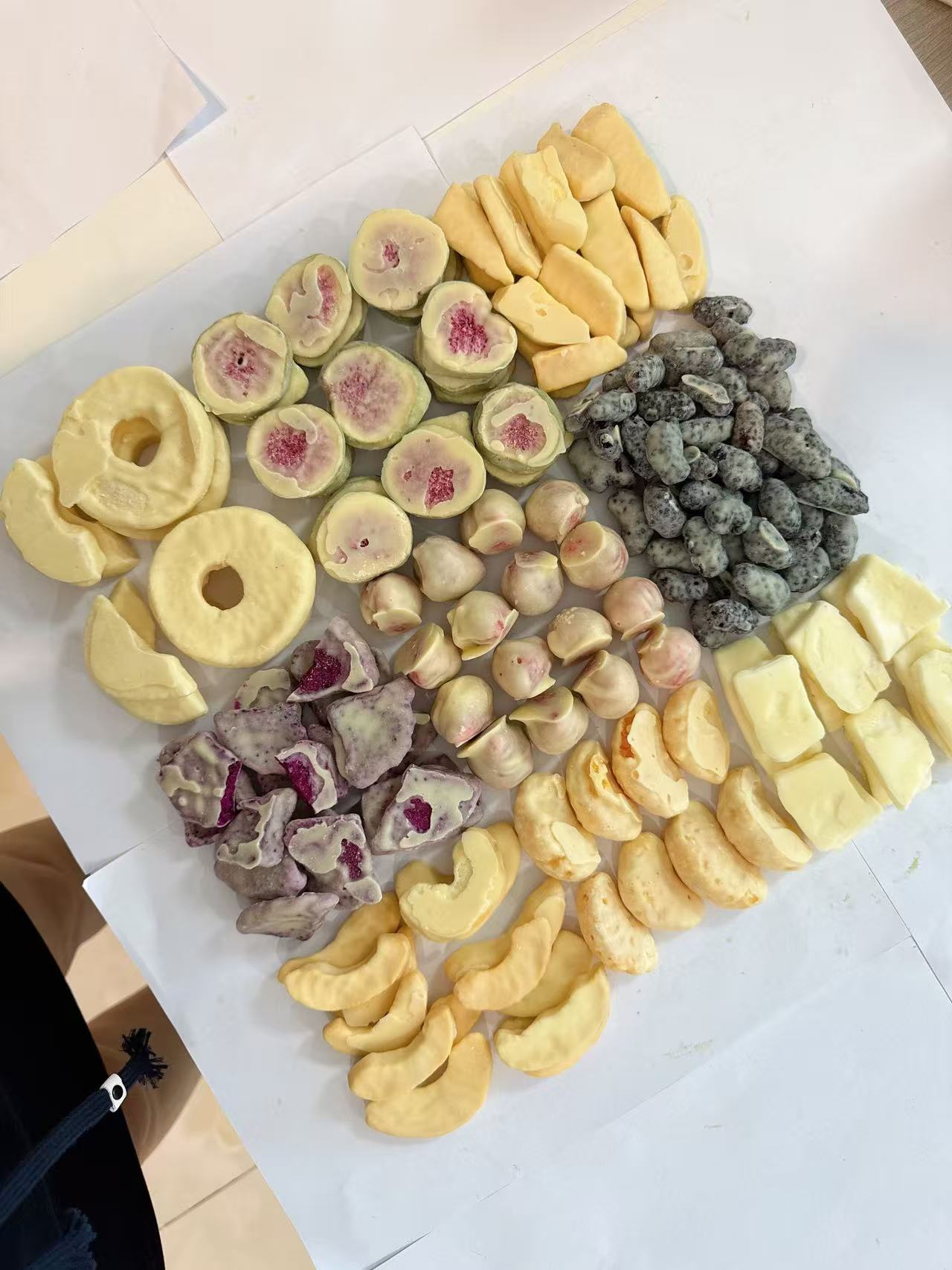
Chocolate bars, coated products, decorations and other confectionery formats may use whole berries, pieces, granules or powder. Select the format according to the desired visual contrast, fruit identity, flavor intensity and incorporation method. Particle size can affect distribution and the way inclusions fit the finished product.
Moisture condition, breakage and processing exposure need application testing. A dry sample that tastes crisp on its own does not prove compatibility with every chocolate or confectionery formulation. Check the fruit after the intended process and in the final packaging rather than relying on direct tasting alone.
Freeze-Dried Fruit for Dairy and Yogurt
Freeze-dried fruit placed directly in a high-moisture dairy system will absorb moisture and rehydrate. It should not be specified on the assumption that it will remain indefinitely crisp inside yogurt. The product developer first needs to define the objective: visible fruit pieces, flavor release, color contribution, controlled rehydration, a separate topping or use in a dry dairy mix.
Test the fruit in the actual serving format and over the relevant evaluation period. A separate dry topping has different texture and packaging requirements from fruit incorporated into yogurt before distribution.
Application Comparison
| Specification factor | Cereal | Granola | Chocolate / confectionery | Dairy / yogurt |
|---|---|---|---|---|
| Format consideration | Pieces, dices or slices that distribute through the blend | Pieces suited to cluster size and mixing route | Whole fruit, pieces, granules or powder by product design | Pieces, powder or separate topping by moisture exposure |
| Piece-size importance | Serving distribution and visual identity | Balance with cluster size | Fit with bar, coating or decoration | Visibility and rehydration behavior |
| Breakage sensitivity | Mixing and filling can generate fines | Dense clusters can damage fragile formats | Handling affects visible inclusions | Depends on whether fruit is dry-packed or incorporated |
| Moisture exposure | Usually a dry system, but packaging still matters | Review process and ingredient exposure | Review fruit and surrounding formulation | High when mixed directly into yogurt |
| Texture objective | Crispness or identifiable fruit bite | Balance with cluster texture | Texture contrast or flavor contribution | Rehydration, flavor or separate crisp topping |
| Processing consideration | Blending and filling | Incorporation point, mixing and possible heat exposure | Inclusion method and processing conditions | Direct incorporation versus separate pack |
| Packaging consideration | Barrier for the complete dry blend | Barrier plus protection from handling damage | Protection for the finished confectionery system | Separate topping barrier or dairy-pack evaluation |
| Trial priority | Distribution and breakage | Process survival and final bite | Compatibility and finished appearance | Rehydration and serving performance |
Why Moisture Changes Freeze-Dried Fruit Texture
Freeze-dried fruit has a porous structure and readily absorbs moisture from humid air or surrounding food components. Moisture exposure can therefore lead to moisture absorption, texture change and loss of crispness. In a mixed food, moisture can also migrate between components during storage.
This section is intentionally brief. The separate guide, Why Does Freeze-Dried Fruit Become Soft?, explains the diagnostic path for storage, package opening and barrier conditions. For an application specification, record where moisture exposure occurs and test the fruit in the final food and package.
Pieces, Granules or Powder: How Should Buyers Decide?
| Requirement | Pieces / dices | Granules | Powder |
|---|---|---|---|
| Visible fruit identity | High | Moderate | Low |
| Texture contribution | Distinct piece-level bite | Smaller texture points | No intact-fruit bite |
| Flavor dispersion | Localized | More distributed | Broad dispersion |
| Distribution | Depends on size and bulk density | Usually easier across a mix | Requires powder-handling review |
| Breakage sensitivity | Relevant during handling | Particle range and fines matter | Flow and moisture pickup replace piece-breakage concerns |
| Application fit | Cereal, granola, chocolate inclusions and toppings | Smaller inclusions, coatings and mixes | Bakery, confectionery, flavor and color applications |
What Should Be Included in a Freeze-Dried Fruit Specification?
A commercial specification should describe the material being purchased and the acceptance points relevant to the application. Exact values are product- and customer-dependent; they should not be inferred from a generic product name.
- Fruit type and variety where relevant
- Whole, sliced, diced, granulated or powdered format
- Piece dimensions or particle-size range
- Appearance and color expectations
- Flavor and texture expectations
- Moisture requirement
- Water activity when required by the buyer
- Breakage or fines tolerance
- Foreign-material requirements
- Microbiological requirements
- Ingredient and allergen considerations
- Bulk packaging and net weight
- Labeling and destination-market requirements
- Shelf-life requirement
- COA and testing requirements
Document and certificate availability must be confirmed for the selected product, facility and destination. This guide does not state universal limits or certificate coverage.
After selecting the format, define how intact pieces, broken pieces and fines will be classified and measured. The guide to writing breakage and fines into a commercial specification provides the inspection framework.
How Should Food Manufacturers Evaluate Samples?
Do not approve a bulk ingredient only by opening the pouch and tasting it. Direct tasting is useful for initial appearance, aroma, flavor and texture, but commercial approval also needs an application trial.
- Review the fruit as supplied.
- Run it through the intended mixing or manufacturing step.
- Examine distribution, breakage and texture immediately after incorporation.
- Evaluate the finished packaging route.
- Include the product in relevant application and shelf-life testing.
Record appearance, flavor, texture, piece integrity, fines, distribution, moisture behavior and interaction with other ingredients. The companion guide on why samples and bulk orders can differ explains why an approved commercial specification is more reliable than a memory of one attractive sample.
What Information Should You Send When Requesting a Sample?
- Intended application
- Fruit type
- Preferred format
- Target piece size or particle direction
- Texture expectation
- Moisture requirement, if already defined
- Relevant processing conditions
- Bulk or retail packaging requirement
- Destination market
- Estimated order or annual usage
If your specification is still being developed, start with the intended application, fruit format and target piece size. These details make the first sample discussion much more useful.
From Application Requirement to Commercial Specification
For the wider transition from retail packs to industrial purchasing, see how to source freeze-dried fruit for food production. Product availability and format directions can be reviewed through the freeze-dried fruit range, including product-specific guidance for freeze-dried apple and freeze-dried strawberry.
Frequently Asked Application Questions
What freeze-dried fruit format is best for cereal?
There is no universal best format. Compare pieces, dices or slices according to cereal size, serving distribution, breakage during blending, visual identity and the finished package.
Can freeze-dried fruit be used in granola?
Yes, but the incorporation point and process need testing. Review cluster size, mixing damage, heat or oil exposure, final texture and packaging rather than assuming the cereal specification will transfer unchanged.
Can freeze-dried fruit be mixed with chocolate?
Freeze-dried fruit can be evaluated for chocolate and confectionery applications. Format, particle size, moisture condition, breakage, incorporation method and final-pack performance should be tested in the actual formulation.
Can freeze-dried fruit be used in yogurt?
It can contribute visible fruit, flavor or color, but it will absorb moisture and rehydrate when placed directly in yogurt. Decide whether the fruit is incorporated, used as a separate topping or added to a dry preparation.
What is the difference between freeze-dried fruit pieces and powder?
Pieces retain visible identity and may contribute texture. Powder distributes flavor and color more broadly but requires separate review of ingredient declaration, particle behavior, moisture protection and flow.
Why does freeze-dried fruit become soft after mixing?
Moisture can move from humid air or other food components into the porous fruit structure. The resulting moisture absorption changes texture and can reduce crispness.
What size should a food manufacturer specify?
Specify a size range that fits the serving, mixing process, dosing equipment and visual objective. No single dimension is suitable for cereal, granola, chocolate and dairy applications.
What information is needed for a sample request?
Provide the application, fruit type, preferred format, target size, processing conditions, packaging route, destination and estimated volume. Add moisture or texture requirements when already defined.
How should samples be tested before a bulk order?
Review the fruit as supplied, through the intended process, after incorporation and in the final package. Record appearance, flavor, texture, breakage, distribution and moisture behavior against the proposed specification.
Discuss Your Food Application
Send the application, fruit type, preferred format, target piece size, packaging requirement, destination market and estimated volume. GlobalCrispy can review the request against available specifications and sample options without assuming a fixed MOQ or technical limit.