From Retail Packs to Bulk: How to Source Freeze-Dried Fruit for Food Production
A small snack, cereal or bakery company may begin product development by buying 20 to 50 retail bags of freeze-dried strawberries online. That works for kitchen trials. Once monthly usage moves into recurring production, retail packs become expensive, inconsistent and awkward to plan around.
At that point, the sourcing question changes from “Which freeze-dried strawberry tastes good?” to “What specification of freeze-dried strawberry will work reliably in my production line?” This guide is written for food manufacturers, ingredient buyers, private-label snack brands, importers and distributors moving from retail packs to bulk freeze-dried fruit sourcing.
Why Retail Freeze-Dried Fruit Stops Working for Commercial Production
Retail packs are built for consumer sale. They help a product developer taste a fruit direction, check visual appeal and make early bench samples. They are not built to control ingredient specification, batch consistency, freight efficiency or production documentation.
For commercial production, the buyer needs to know whether the fruit can be supplied in a repeatable format, packed in a way the factory can handle and documented for the destination market. A retail pouch rarely answers those questions.
| Buying factor | Retail packs | Bulk supply |
|---|---|---|
| Typical purchase size | Small bags for tasting or kitchen trials. | Cartons or bulk-packed product for recurring production use. |
| Specification control | Limited control over variety, cut size or particle size. | Specification can be discussed around format, application and buyer requirements. |
| Packaging | Consumer-facing pouches. | Food-grade inner packing, cartons or project-specific packaging routes. |
| Batch consistency | Often difficult to trace or repeat for production planning. | Batch and lot discussion can be part of quality review and order confirmation. |
| Documentation | Usually limited to retail label information. | Buyers can request product specifications, ingredient information and available documents. |
| Cost structure | Includes small-pack handling and retail packaging cost. | Pricing reflects raw material, grade, format, packaging, order volume and freight basis. |
| Production planning | Useful for testing, weak for repeat supply. | Built around sample approval, quotation, specification and commercial order planning. |
Start With the Application, Not the Fruit
A request for “freeze-dried strawberry” or “freeze-dried mango” is only the beginning. The same fruit may need a different form depending on how it will be used in the finished food.
Cereal and Granola
Cereal and granola buyers usually care about slices, dices or pieces that survive mixing and packing well enough for the finished product. Breakage, powder generation, moisture migration and visual contrast matter more than a perfect tasting piece eaten straight from the bag.
Chocolate and Confectionery
Chocolate and confectionery production may use whole berries, pieces or powder. The key questions are particle size, moisture sensitivity, flavor intensity and whether the fruit remains suitable during processing and in the finished product.
Bakery Products
Bakery manufacturers may use powder, granules or pieces depending on whether the fruit provides flavor, color, decoration or inclusion. A format that looks attractive in a snack pouch may not be the most efficient choice inside a bakery formulation.
Beverage and Powder Applications
For beverages and powder blends, buyers should discuss powder characteristics, seed content where relevant, dispersibility expectations, color, flavor and hygroscopicity. A good-tasting powder still needs to work in the buyer’s blending and packing process.
Snack and Private-Label Packs
For retail snack packs, whole-fruit appearance, size uniformity, broken ratio and crisp texture can affect shelf appeal. Private-label snack projects should also review pouch route, pack weight and carton protection before treating samples as the commercial standard.
There is no universal “best grade” of freeze-dried fruit. The correct specification depends on the product being manufactured.
The 7 Specifications Buyers Should Define Before Requesting a Quote
This is where many retail-to-bulk sourcing projects become clearer. A supplier can respond much more usefully when the buyer defines the commercial requirement instead of asking for a general price.
1. Fruit Variety and Origin
Strawberry, apple, mango, raspberry, blueberry and other fruits can vary by variety, growing season and raw-material condition. Do not assume two samples with the same fruit name will have the same sweetness, color, aroma or texture.
2. Cut Size
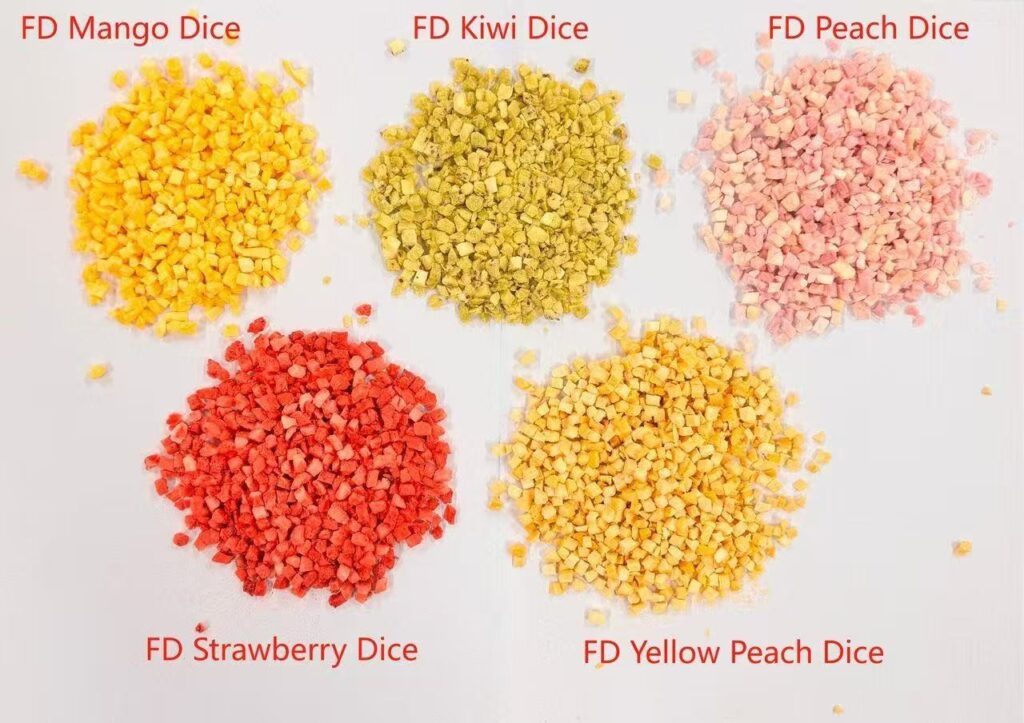
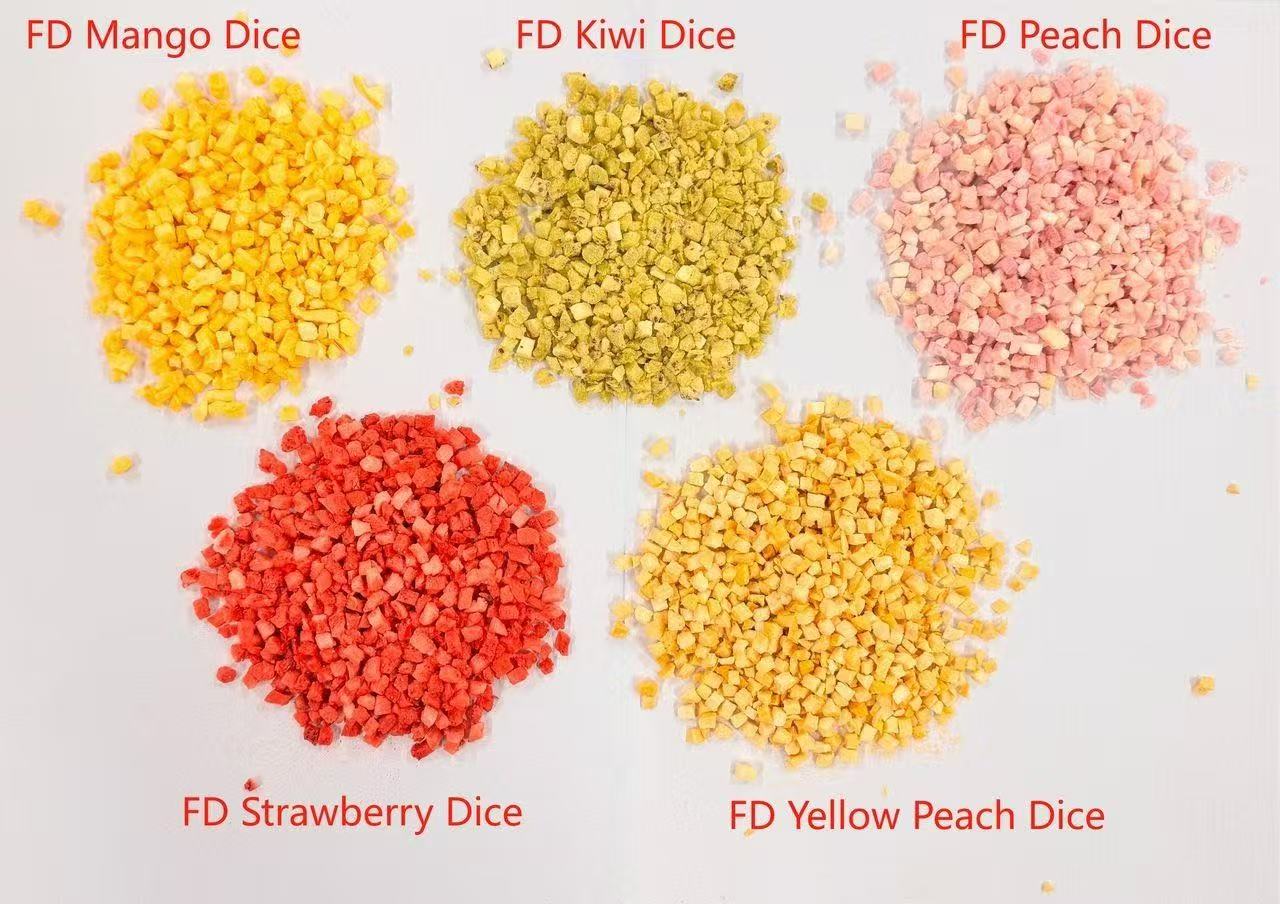
Whole fruit, slices, dices, pieces, granules and powder serve different production purposes. Requesting only “freeze-dried strawberry” is usually too broad for industrial purchasing. The buyer should state the desired format and whether the format is for visible appearance, blending, filling, topping or flavoring.
3. Particle Size
Particle size matters for dices, granules and powder. Production buyers should define the acceptable range or at least explain the finished product use. A powder for a beverage blend may be judged differently from small fruit pieces used in chocolate or granola.
4. Broken Pieces and Powder Percentage
Breakage is not always a defect. For cereal or chocolate applications, certain piece sizes may still be commercially useful. For a premium retail snack pack, visible broken pieces and powder may reduce consumer appeal. Define what your company considers acceptable before comparing quotations.
5. Moisture and Texture
Moisture condition can affect crispness, shelf life, powder flow, chocolate processing and packing performance. Do not assume one universal moisture specification applies to every fruit and application. Agree on the relevant product specification with the supplier before approval.
6. Ingredients and Additives
Confirm whether the product is 100% fruit or contains sugar, carriers, flavorings or anti-caking agents. This is especially important for powders and formulated applications where ingredient declaration affects label review and finished-product positioning.
7. Packaging Format
Discuss food-grade inner bags, outer cartons, bulk bag sizes and moisture or oxygen protection where relevant. Packaging should fit both international transportation and the way your factory opens, stores and uses the ingredient.
Whole Fruit, Pieces or Powder: Which Format Is More Economical?
The most economical format is the one that works in the finished product with acceptable loss, not simply the lowest price per kilogram.
| Format | Best suited for | Procurement note |
|---|---|---|
| Whole fruit or slices | Premium snack packs, decoration and visible inclusions. | Useful when appearance carries value; may be unnecessary if the process will crush the fruit. |
| Pieces or dices | Cereal, granola, chocolate, bakery and mixed snack applications. | Often easier to dose or mix; define acceptable piece size and fines. |
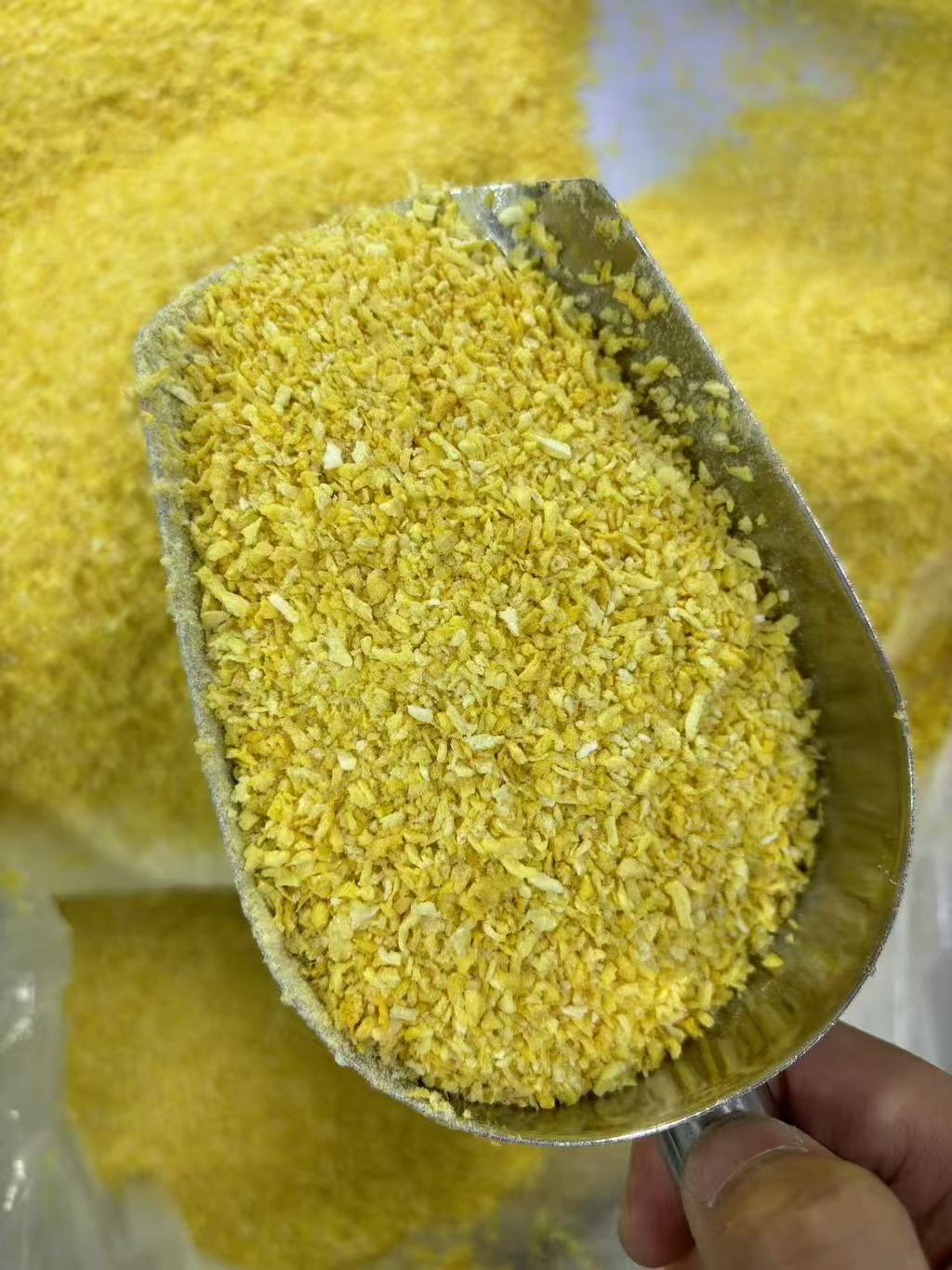
| Powder | Flavoring, coloring, beverages, baking mixes and confectionery. | Review particle expectations, ingredient declaration and flow behavior. |
Using premium whole fruit in a product where the fruit will be crushed during manufacturing may unnecessarily increase ingredient cost. Buying low-grade broken material for a visible retail snack may reduce shelf appeal. Match the format to the production use.
Why Bulk Pricing Is Not Just “Retail Price x Quantity”
Industrial pricing changes with raw fruit cost, season, grade, cut size, yield, powder or piece specification, packaging route, order volume, production scheduling, freight basis and destination market requirements.
Two quotations for “freeze-dried strawberry” can differ substantially even when both descriptions sound similar. One may refer to larger slices for visible snack packing; another may refer to smaller pieces for ingredient blending. One may include a different packaging route or document requirement. Before comparing price, compare the specification.
MOQ: What Buyers Should Ask Instead of Just “What Is Your MOQ?”
MOQ can depend on product type, specification, packaging, whether the item is already in production, whether custom cutting is required and whether custom retail packaging is required. A single MOQ answer without context can be misleading.
Better questions include:
- What is the MOQ for standard bulk packaging?
- Is there a different MOQ for custom specifications?
- Can several freeze-dried fruits be combined in one shipment?
- Is trial-order quantity available?
- What production lead time applies to this specification?
For a deeper explanation, see the guide on what affects MOQ in freeze-dried food manufacturing.
Request Samples That Match the Commercial Specification
Random samples are useful for first tasting, but they are not enough for production approval. A useful sample request should specify the fruit, format, cut size, intended application, packaging preference and estimated monthly or annual usage if known.
Example request:
We are developing a granola product and are looking for freeze-dried strawberry pieces approximately [size range]. Expected usage is around [X] kg per month. Please advise available specifications, bulk packaging, MOQ and sample options.
That kind of request helps the supplier avoid sending unrelated retail-style samples. For a broader process, use the sample evaluation guide.
What Documents Should a Food Manufacturer Ask For?
Depending on the destination market and application, buyers may ask for a product specification sheet, ingredient declaration, allergen statement, COA, microbiological information, country of origin information, shelf-life information, packaging specification and relevant certificates required by the market.
Do not assume a certificate applies automatically to every fruit, format or product category. Ask which documents and certifications are available for the selected product and shipment. The Quality Control page is the right place to review GlobalCrispy’s available quality and documentation information.
How to Compare Two Freeze-Dried Fruit Quotations Properly
A lower price per kilogram does not necessarily mean a lower ingredient cost in production. Excessive powder, unsuitable particle size or the wrong packaging route may create additional production loss.
| Compare this item | Why it matters |
|---|---|
| Fruit variety and origin | Influences flavor, color, maturity and seasonal consistency. |
| Cut size and particle range | Affects appearance, dosing, mixing, filling and breakage. |
| Moisture specification | Relevant to crispness, flow, storage and processing behavior. |
| Broken ratio and powder percentage | Changes usable yield depending on the application. |
| Ingredients | Important for label review, formulation and buyer positioning. |
| Packaging and net weight | Affects handling, freight efficiency, storage and factory use. |
| MOQ and lead time | Should be compared for the same specification and packaging route. |
| Incoterm and freight basis | Changes landed cost and responsibility during shipment. |
| Documentation | Must match the product, destination and buyer requirements. |
A Practical Bulk Sourcing Workflow
Questions to Send Your Supplier Before Ordering
- What cut sizes are available for this fruit?
- Can you provide whole, slices, dices, pieces, granules or powder?
- What is the typical broken-piece or fines expectation for this format?
- What bulk packaging options are available?
- What MOQ applies to the selected format and packaging route?
- What lead time applies after sample and specification approval?
- Can samples match the quoted commercial specification?
- What product documents are available for this item?
- Can mixed products be shipped together if the order includes several fruits?
- How should the product be stored after opening?
If the question is mainly about texture after opening or moisture exposure, see why freeze-dried fruit becomes soft. If the issue is specific to apple slices, the guide on crispy vs chewy freeze-dried apple slices explains how to diagnose piece-level texture differences.

When Does It Make Sense to Switch From Retail Packs to Bulk?
The switch usually becomes worthwhile when usage becomes recurring, packaging labor increases, retail pack pricing becomes significant, consistent specifications become important, production planning requires reliable supply or the buyer begins importing pallet or container quantities.
The trigger is usually not one exact volume. It is the point where consistency, specification control and procurement efficiency become more important than the convenience of retail packaging.
Talk to a Freeze-Dried Fruit Supplier About Your Application
If you are moving from retail freeze-dried fruit packs to bulk ingredients, send the fruit required, intended application, preferred format, target cut size, estimated quantity and destination country.
GlobalCrispy can then discuss suitable specifications, available packaging, sample options and MOQ for the selected project. For commercial product options, start with the freeze-dried fruit category, or review examples such as freeze-dried apple, freeze-dried strawberry and freeze-dried mango.
Request Bulk Pricing & Samples
Share the fruit, application, preferred format, estimated quantity and destination market. Final specifications and document availability can be confirmed according to the selected product and project requirements.